
Publishing Process
Publishing Process
The GlobeIS Journal adheres to a structured, transparent, and rigorous publishing workflow to maintain high academic standards and ensure the integrity of scholarly communication.
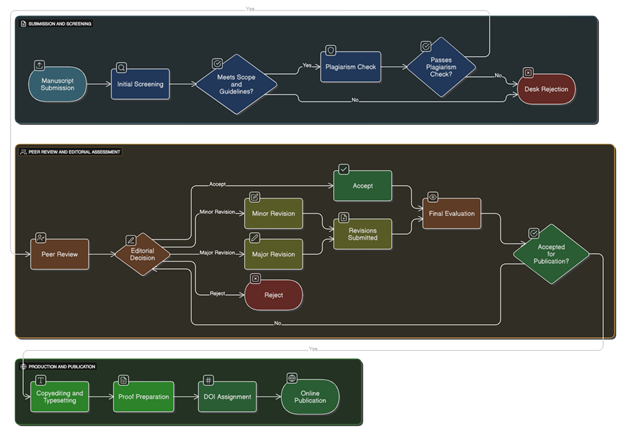
Editorial Workflow
- Initial Screening
The editorial team conducts a preliminary assessment to ensure the manuscript meets the journal’s scope, formatting requirements, and submission guidelines. - Plagiarism Check
All submissions are screened using advanced plagiarism detection software to verify originality and ensure compliance with ethical publishing standards. - Peer Review
The journal employs a double-blind peer review process involving two or more subject-matter experts. Reviewers provide constructive feedback typically within 3–6 weeks. - Editorial Decision
Based on reviewer reports, the Editor-in-Chief issues one of the following decisions: Accept, Minor Revision, Major Revision, or Reject. - Revisions (if required)
Authors submit a revised manuscript accompanied by a detailed point-by-point response to reviewer comments. - Final Decision & Acceptance
The revised manuscript undergoes final evaluation. Accepted papers proceed to copyediting, typesetting, and proof preparation. - DOI Assignment & Online Publication
Each accepted article is assigned a Digital Object Identifier (DOI) and is published online in its final form immediately upon completion of production.
Timeline and Expectations
Publication Timeline GlobeIS is committed to a rapid and transparent editorial process.
-
Initial Screening: 1 week.
-
Peer Review: Typically 3–6 weeks.
-
Final Decision: 4–6 weeks from submission.
-
Issue Scheduling: Once accepted, articles are published in the next available issue (April, August, or December).
-
Online First: Accepted papers are published online immediately after typesetting to ensure rapid dissemination of research.
For any questions regarding the publishing process or fees, please contact our editorial office at info@globeisjournal.com.
